Most diamond shapes are trying to be circles. The marquise is not. It is a long, narrow brilliant with two sharp points, like an eye or a hull seen from above — and that outline is exactly why it has survived three centuries of fashion while other shapes came and went.
The name comes from a specific commission: in 1745, King Louis XV of France asked his court jeweller to cut a diamond shaped like the lips of his mistress, the Marquise de Pompadour. Whatever you think of the origin story, the brief was unusual — make a diamond that looks like a mouth — and the resulting silhouette turned out to do something no round stone can: make whatever is above it look longer.
Why it makes a neckline look longer
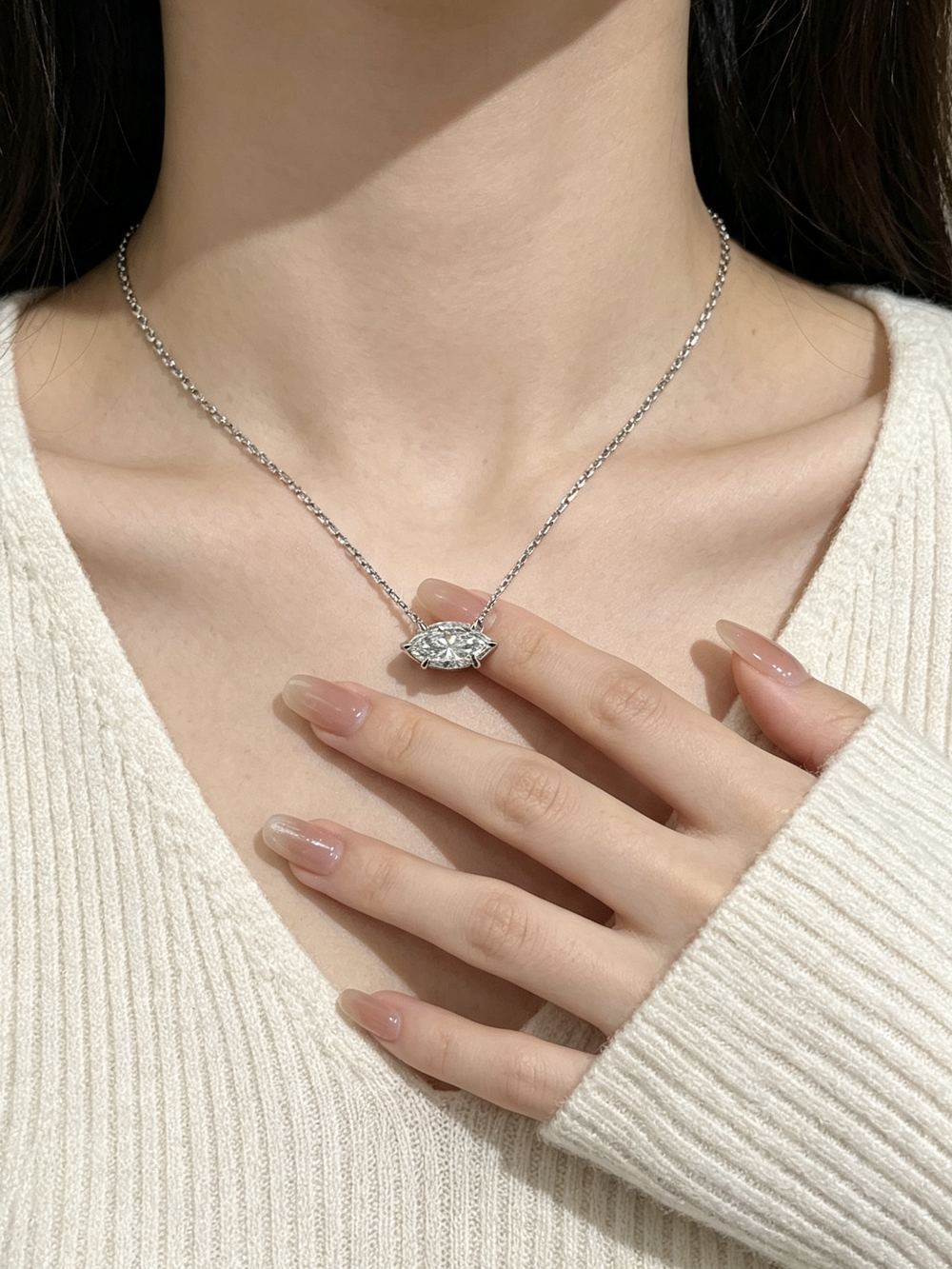
The eye follows lines, not areas. A round stone draws the eye in a loop; a marquise draws it along its axis. Worn on a chain, the long axis runs horizontal across the collarbones — the widest part of the upper chest — so the stone reads as a level line stretched between two points, the same trick a wide neckline pulls with fabric. On a finger, the axis runs along the digit and adds apparent length the same way.
This is also why marquise stones look bigger than they measure. A 1.00 ct marquise has more surface area on top than a 1.00 ct round brilliant — the shape trades width for length — so the same weight wears like a larger stone. That is not marketing; it is arithmetic that works in the buyer's favour.
The three things to check before buying
First, the length-to-width ratio. Divide length by width: between roughly 1.85 and 2.1 is the classic range. Below that the stone starts to look like an oval with opinions; much above 2.2 and it reads as a novelty. Every reputable report lists the measurements, so this is a check you can do at home with a calculator.
Second, the bow-tie. Because a marquise is long and shallow, the middle of the stone can leak light and show a grey band across the centre — the shape of a bow tie, hence the name. Every marquise has one to some degree; the question is whether it is a whisper or a stripe. Look at photos taken straight on in daylight, not only the angled beauty shot.
Third, the points. The two ends are where marquise stones chip, and where settings fail first. A good setting grips each point in metal — prong, claw or bezel — rather than leaving the tip as the outermost thing on the piece. This matters more over years of wear than any specification on a certificate.
| Shape | Outline | What it does to the eye | Watch for |
|---|---|---|---|
| Round brilliant | Circle | Even sparkle, no direction | Looks smaller per carat than elongated shapes |
| Marquise | Boat, two points | Lengthens the line it sits across | Bow-tie shadow; fragile points |
| Oval | Soft ellipse | Lengthens, gentler than marquise | Can look like a substitute when compared directly |
| Pear | One point | Points down the hand or throat | Single point needs protection too |
| Emerald | Rectangle, stepped | Architectural, hall-of-mirrors | Shows clarity flaws more than brilliants |
East-west or north-south?
A pendant marquise can hang with its points running up and down the chain — north-south, the way solitaires are usually photographed — or laid sideways across the throat — east-west. The two read completely differently. North-south looks formal and drops like a drop earring; east-west turns the stone into a horizontal accent that sits still and works with open collars, crew necks and everything in between.
Our marquise solitaire is set east to west for that reason: the stone behaves like a horizon line at the collarbone, and both pointed ends sit inside claws rather than hanging off the chain. Fixed 45 cm chain, so it lands just below the collarbone where the trick actually works.
What a lab-grown marquise changes — and what it doesn't
Nothing about the cut depends on where the carbon came from. Marquise is a cutting decision — how the rough is mapped, how the facets are placed — and a lab-grown stone gives the cutter the same material to work with. What changes is the price you pay for a clean, well-proportioned stone, because you are not paying for a mining operation first.
That headroom is why elongated cuts are a good place to start with lab-grown stones: the shapes that show size most dramatically — marquise, oval, pear — are the ones where the per-carat saving buys you the most visible diamond.
If you are choosing between shapes, try the stone against your own neckline rather than a photo of someone else's. A marquise worn east-west at 45 cm does its work on a specific body, at a specific length — that is the combination to judge, not the stone on a white card.
Written by the Selena Fine Jewelry atelier · published 10 November 2026 · questions? Write to us.